File ITR-1 (Sahaj) Online
File ITR-1 (Sahaj) Online – FAQs
1. What are the types of income that shall not form part of ITR-1 form?
Following are the types of income that shall not form part of ITR-1 form:
(a) Profits and gains from business and professions.
(b) Short term Capital gains.
(c) Long-term capital gain u/s 112A exceeding ₹ 1.25 lakhs
(d) Income from more than two house properties.
(e) Income under the head other sources which are of following nature:
(i) winnings from lottery.
(ii) Activity of owning and maintaining racehorses.
(iii) Income taxable at special rates u/s 115BBDA or section 115BBE.
(iv) Income/Relief from Retirement Benefit Account.
(f) Income to be apportioned in accordance with provisions of section 5A
(g) Agriculture Income more than 5 thousand
Also, ITR-1 cannot be used by a person who:
(h) is a director in a company
(i) has held any unlisted equity shares at any time during the previous year
(j) has any asset (including financial interest in any entity) located outside India
(k) has signing authority in any account located outside India
(l) has income from any source outside India
(m) is a person in whose case tax has been deducted u/s 194N (Income Tax Act,1961)
(n) is a person in whose case payment or deduction of tax has been deferred on ESOP
(o) has any brought forward loss or loss to be carried forward under any head of income
(p) has total income exceeding ₹ 50 lakhs.
2. What are the key changes in ITR-1 form for AY 2026-27?
Below are the key Changes in ITR-1 for AY 2026-27:
• Two House Properties: Taxpayers can now report income from up to two house properties in ITR-1, rather than just one house property.
• Unrealized Rent Field: A new, specific field for "rent which cannot be realized" has been added, aiding taxpayers with rented properties.
• Foreign Asset Reporting: Requirements for reporting foreign retirement benefits have been removed.
3. Is it mandatory to define the nature of employment while filing of return?
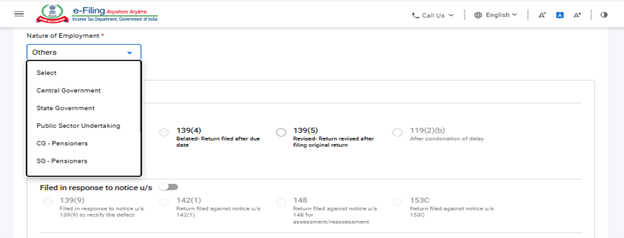
Yes, it is mandatory to select the nature of employment while filing of returns from the following options:
(a) Central Government Employee
(b) State Government Employee
(c) Employee of Public Sector Enterprise (whether Central or State Government)
(d) Pensioners (CG/SG/PSU/OTHER)
(e) Employee of Private Sector concern
(f) Not applicable (in case of family pension income
4. Is it mandatory to fill in a secondary address while filing the return?
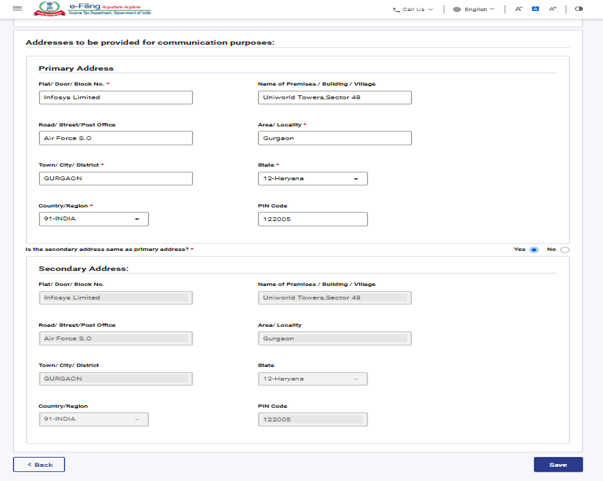
Yes, it is mandatory to provide the secondary address details while filing the return. After entering the primary address, a prompt appears asking, “Is the secondary address the same as the primary address?”. If Yes is selected, the details will auto-populate from primary address; if No is selected, the secondary address details must be entered mandatorily.
5. Do I need to file any form if I want to opt out or opt in for the New Tax Regime in ITR-1 or ITR-2?
No, you are not required to file any form for opting in or opting out of New Tax Regime in ITR-1 or ITR-2. You can simply tick “Opting out of New Regime” in the ITR form without the need to file any Form. Only those taxpayers who file ITR-3, ITR-4 or ITR-5 must submit Form 10IEA if they have business income. Individuals and HUFs filing their returns in Forms ITR-1 or 2 are not required to submit Form 10IEA before filing the return.
6. What documents do I need to file ITR-1?
You are required below documents to file ITR:
• Form 16
• Form 16A
• Form 26AS
• AIS
• Pay Slip
• Bank Statements
• Housing Loan Interest Certificates
• House rent receipt (if applicable),
• Rental Agreement
• Receipts for Donation Made
• Investment, premium payment receipts - LIC, ULIP etc. and other relevant Documents to furnish information in ITR form.
ITR forms are annexure-less forms, so you are not required to attach any document (like proof of investment, TDS certificates) along with your return (whether filed manually or electronically). However, you need to keep these documents for situations where they need to be produced before tax authorities such as in cases such as assessment, inquiry, etc.
7. What precautions should I take while filing the return of income?
• Carefully select the tax regime.
• Download AIS and Form 26AS and check the actual TDS / TCS / tax paid. If you see any discrepancy, you should reconcile it with the Employer / Tax Deductor / Bank.
• Compile and carefully study the documents to be referred to when filing your ITR, like bank statement / passbook, interest certificates, receipts to claim exemptions or deductions, Form 16, Form 26AS (Annual Information Statement), investment proofs, etc.
• Ensure details like PAN, permanent address, contact details, bank account details, etc. are correct in the pre-filled data.
• Identify the correct ITR form (from ITR-1 to ITR-7). Provide all the details in return form such as total income, deductions (if any), interest (if any), taxes paid / collected (if any), etc. No documents are to be attached along with ITR form.
• e-File the return of income on or before the due date. The consequences of delay in filing returns include late filing fees, losses not getting carried forward, deductions and exemptions not being available.
• After e-Filing the return, E-Verify it. If you want to manually verify your return, send the signed physical copy of ITR-V Acknowledgement (by speed post) within appropriate timelines (30 days) of filing the return to Centralized Processing Center, Income Tax Department, Bengaluru 560500 (Karnataka).
8. How do I know which ITR form I need to file?
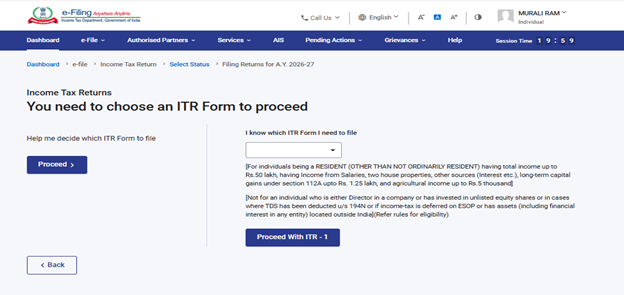
Different ITR forms are prescribed for filing by individual taxpayers depending on their source of income and residential status. To determine the correct ITR Form to file, you can use the ‘Help me’ feature to decide which ITR Form to file. You can then proceed with the set of questions displayed to you to determine the correct ITR form.
9. Is the New Tax Regime a default regime?
Yes. From AY 2024-25, the New Tax Regime is the default option. Every year, you can select between the Old and New Tax Regimes for that Assessment Year.
10. Whether all deductions will be available to claim while filing ITR-1 form?
Yes, all eligible deductions will be available to claim in the return once you change the option of default (New Tax Regime) to old tax regime by selecting the question below as ‘Yes’ under Personal Information in return as per screenshot below:
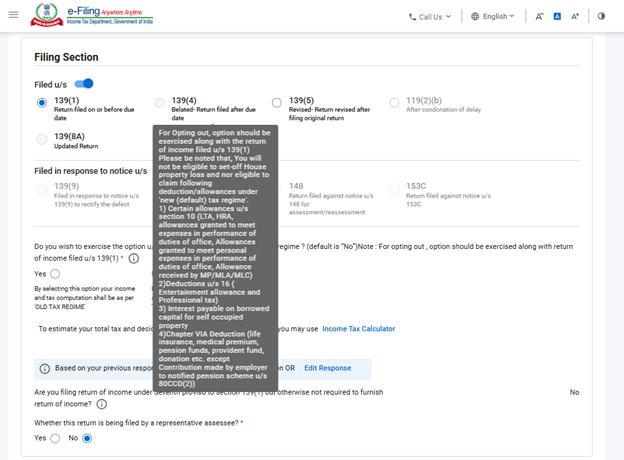
By default, it will be selected as ‘No’ and all deductions under old regime will be disabled in return. Once option will be changed to old tax regime after selecting ‘Yes’ then all deductions will be enabled and then taxpayers will be able to claim all deductions.
11. What is Rebate u/s 87A as per New Tax Regime (Default) and old tax regime?
Currently, section 87A allows individuals to claim a rebate of ₹ 12,500 under the old tax regime and ₹ 60,000 under the New Tax Regime.
12. I am a joint owner of a house with my spouse. We do not have any additional property. Can I file ITR-1 in AY 2026-27 for rental income from such house?
Yes, you can file ITR-1 for the AY 2026-27, If you are a single or joint owner of a single property.
Please Note: From AY 2026-27, you can disclose income from up to two house properties, in ITR-1.
13. Is there any change in house property schedule for ITR-1?
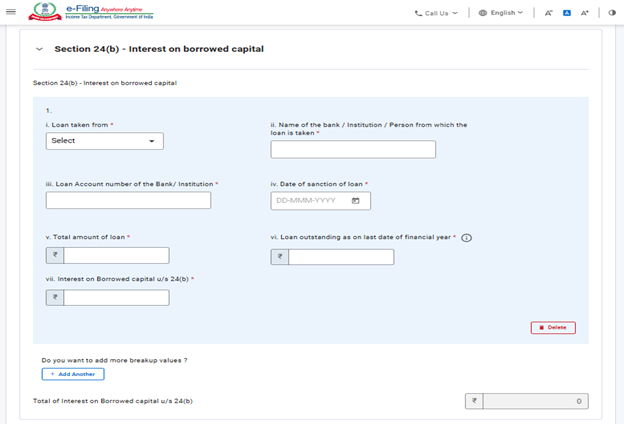
Yes, Income from up to two house properties can be disclosed under the head House property. Also, from AY 2025-26, the new schedule Section 24(b): Interest on borrowed capital is added. In this schedule taxpayer must furnish the details below:
• Loan taken from
• Name of the institution or bank
• Loan Account No.
• Date of sanction of loan
• Total Amount of loans
• Loan outstanding as on last date of financial year
• Interest in borrowed capital
14. What is Advance Tax?
For salaried individuals, advance tax is mostly taken care of through TDS by employers. But other forms of income such as interest on savings bank accounts, fixed deposits, rental income, bonds, or capital gains increase the tax liability. Tax liability needs to be estimated beforehand. If estimated tax amounts to more than ₹ 10,000/- per year, taxpayers need to pay advance tax in quarterly instalments (June, September, December, and March).
15. How is Advance Tax and Self-Assessment Tax calculated and paid?
Advance Tax: Advance Tax for individuals is calculated as given below:
Installments | Advance tax Payment % | Due date for payment |
First installment | 15% tax liability | On or before 15th June |
Second installment | 45% of tax liability (-) Advance tax already paid | On or before 15th September |
Third installment | 75% of tax liability (-) Advance tax already paid | On or before 15th December |
Fourth installment | 100% of tax liability (-) Advance tax already paid | On or before 15th March |
Self-Assessment Tax: After filling out your ITR form with the TDS and advance tax details (if paid), the system computes your income and checks whether tax is still payable. You need to pay it and then fill in the challan details in the return before submitting it.
16. What is the difference between allowance and perquisite? Are these considered as my income?
Allowances are fixed periodic amounts, apart from salary, which are paid by an employer, e.g., conveyance allowance, travelling allowance, uniform allowance, etc. Allowances are considered income and will increase your gross total income on which you will be taxed. Allowances can be taxable, partially exempted, and fully exempted.
Perquisites are benefits you receive because of your official position and are over and above your salary or wage income. These perquisites can be taxable or non-taxable depending upon their nature.
17. Are all donations 100% exempted from tax under old regime?
No, not all donations qualify for 100% exemption from tax. The categories for tax deduction, based on whom you donated to (charitable institution, fund set up by Government, scientific research institution, etc.) are as follows:
- Donations entitled to 100% deduction without qualifying limit
- Donations entitled to 50% deduction without qualifying limit
- Donations entitled to 100% deduction subject to qualifying limit
- Donations entitled to 50% deduction subject to qualifying limit
You need to check the deduction limit on your donation receipt and claim deduction accordingly while filing your return.
18. Is e-Filing and e-Payment the same thing?
No. e-Filing is the process of electronically submitting your Income Tax Return on the e-Filing portal and e-Payment is the process of electronically paying tax on e-Filing portal using e-Pay Tax functionality.
19. I made a calculation mistake while filing my ITR. Can I correct it and re-submit my return?
If you later discover that you have made a mistake in an already submitted return, you can re-submit or revise your return. This is called a Revised Return. Your return must be revised before the end of three months for the relevant AY.
From AY 2026-27 onwards, the due date for filing revised return has been extended up to the end of AY i.e., 31st March of the relevant AY.
20. Do I need to pay any additional fees for filing the Revised return from AY 2026-27 onwards?
Yes, from AY 2026-27 onwards, if the Revised return is filed after 31st December till 31st March of the relevant AY, then an additional payment of fees is required u/s 234I.
21. What is the fee structure u/s 234I of the Income Tax Act, 1961
As per section 234I of Income tax Act, 1961 fee structure is:
- Fee for Total Income up to ₹ 5 Lakh: ₹ 1,000.
- Fee for Total Income exceeding ₹ 5 Lakh: ₹ 5,000.
22. Can I file ITR for last 4 assessment years now?
Yes, you can file ITR-U, if you have missed filing your previous four years ITRs. For current year (AY 2026-27) you can file your regular ITR.
23. What happens if I file Income Tax Return after the due date u/s 139(1)?
In case you miss filing the ITR within the due date u/s 139(1), you can still file your Income Tax Return, but you may be required to pay a late filing fee of up to ₹ 5000/-. Additionally, you will also be required to pay interest on the tax liability (if any).
24. Do I need to file returns if tax has been deducted by my employer / bank?
Yes, employers and banks deduct tax at source on salary and interest income, respectively. You still need to disclose the income on which tax has been deducted and claim credit for TDS in the Income Tax Return
25. Do I need to give additional information if I am claiming deductions u/s 80C?
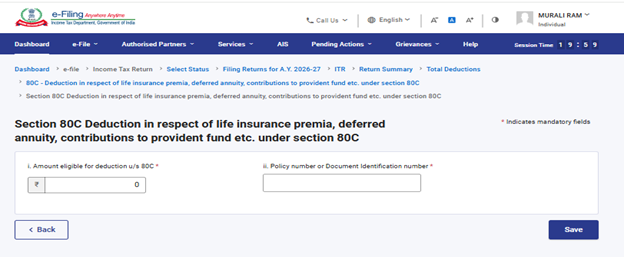
You must give additional information regarding deduction u/s 80C. If you want to claim a deduction u/s 80C, then you must enter the details below:
- Amount eligible for deduction
- Policy no. or Document identification No.
26. Do I need to give additional information if I am claiming deductions u/s 80 CCD (1) or 80CCD(1B)
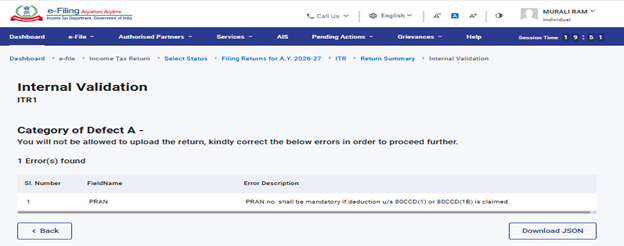
You must give additional information regarding deduction u/s 80CCD (1) or 80CCD(1B). If you want to claim these deductions, then you must enter the PRAN by clicking on PRAN tab.
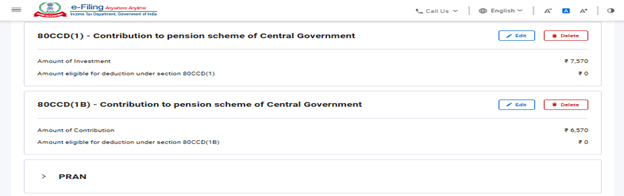
If you forgot to enter PRAN in PRAN tab you will see below validation error:
27. What additional information must I furnish in ITR form if I am claiming deductions u/s 80DD Or 80U?
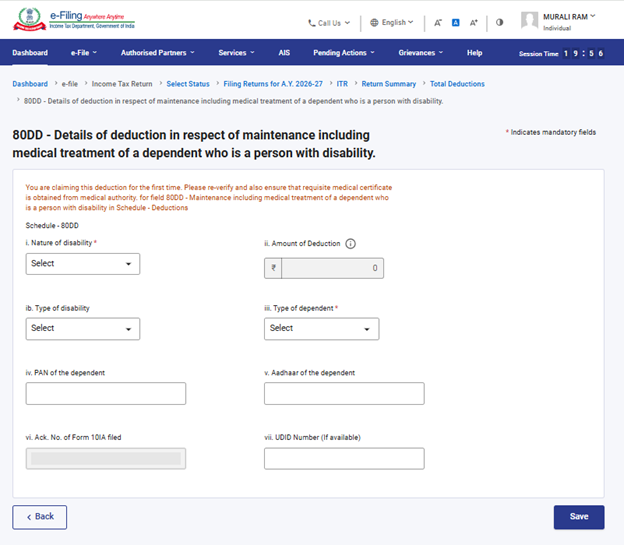
You must give additional information regarding deduction u/s 80DD or Section 80U. If you want to claim deduction u/s 80DD or 80U, then you must enter the details below:
- Nature of Disability
- Type of Disability
- Type of Dependent
- Amount of Deduction
- PAN of Dependent
- Aadhaar of Dependent
- Acknowledgement no. of form 10IA filed
28. Do I need to give additional information if I am claiming deductions u/s 80D?
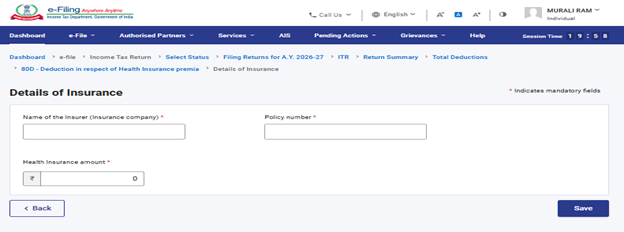
You must give additional information regarding deduction u/s 80D. If you want to claim deduction u/s 80D, then you must enter the details below:
- Name of the Insurer (Insurance Company)
- Policy Number
- Health Insurance amount
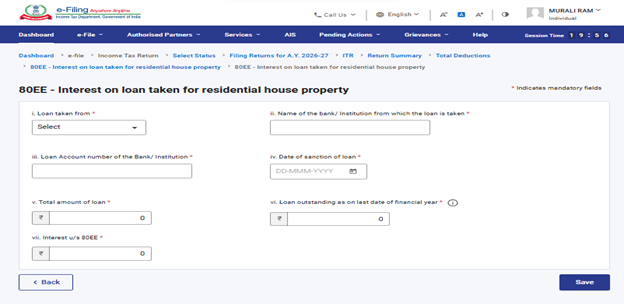
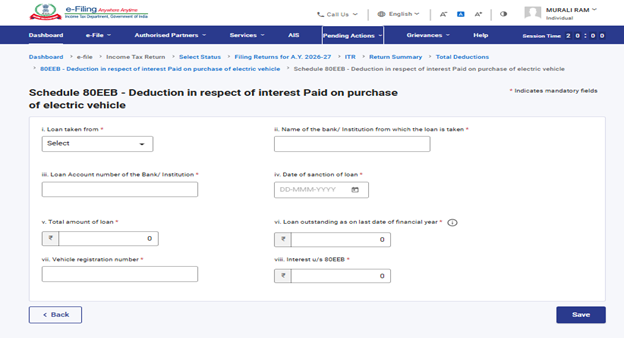
29. Do I need to give additional information if I am claiming deductions u/s 80E, 80EE, 80EEA & 80EEB?
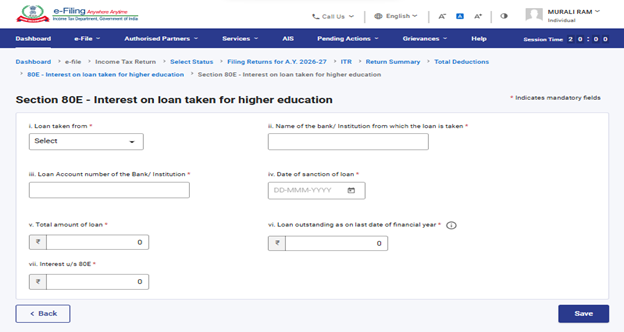
You must give additional information regarding deduction u/s 80E, 80EE, 80EEA and 80EEB. If you want to claim deduction under these sections, then you must enter the details below:
- Loan taken from
- Name of the institution or bank
- Loan Account No.
- Date of sanction of loan
- Total Amount of loan
- Loan outstanding as on date
- Interest amount
Deductions u/s 80E:
Deductions u/s 80EE:
Deductions u/s 80 EEB:
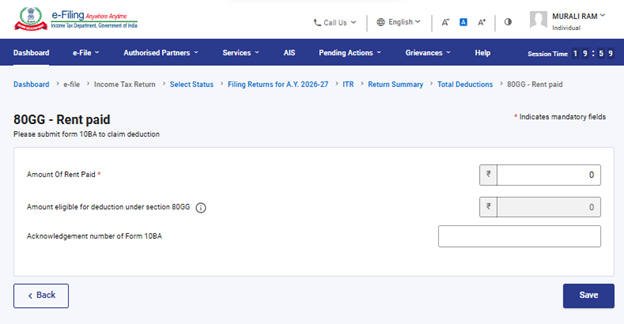
30. Do I need to file any form if I am claiming deduction u/s 80GG?
If you want to claim deduction u/s 80GG then you must mandatorily file Form 10BA before filing the return of Income and enter the details (acknowledgement no.) of Form 10BA in Schedule 80GG while filing the Return of Income.
31. Do I need to file any form if I am claiming deduction u/s 80DD and 80U?
If you want to claim deduction u/s 80DD and 80U then you must mandatorily file Form 10IA before filing the return of Income and enter the details (Date of filing form and acknowledgement no.) of Form 10IA in Schedule 80DD and 80U while filing the return of Income.
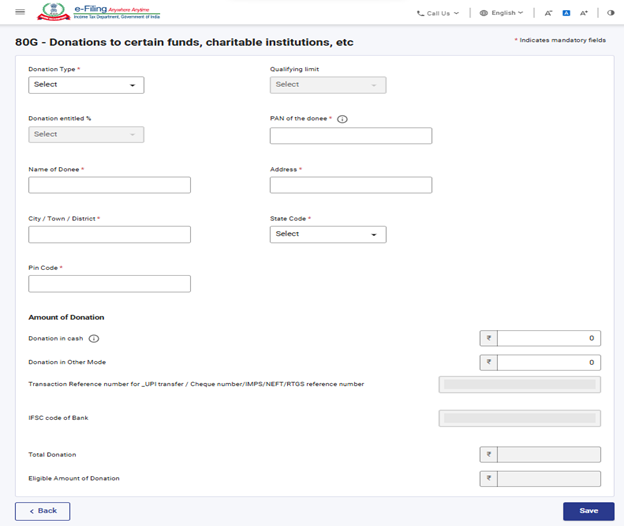
32. Do I need to give any additional information if I am claiming deduction u/s 80G?
You must give additional information regarding deduction u/s 80G. If you want to claim deduction under this section, then you must enter the details below:
- Donation type
- Pan of the Donee
- Name of the Donee
- Address of the Donee
- Donation in cash
- Donation in other mode
- Transaction Reference number for _UPI transfer / Cheque number/IMPS/NEFT/RTGS reference number
- IFSC code of Bank
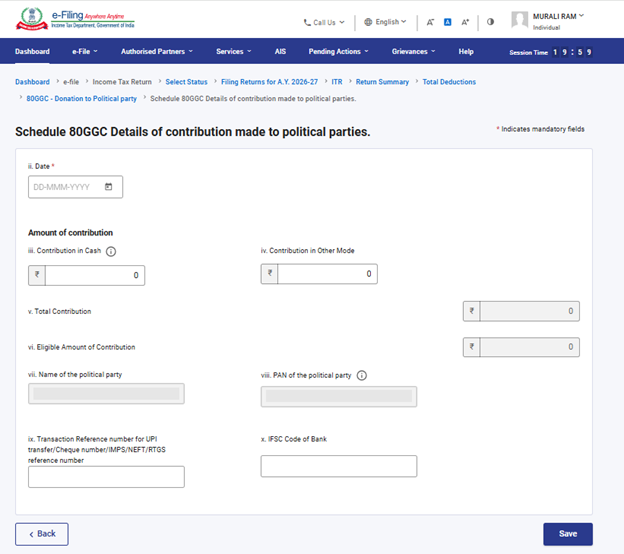
33. Do I need to provide any additional information if I am claiming deduction u/s 80GGC?
You must give additional information regarding deduction u/s 80GGC. If you want to claim deduction under this section, then you must enter the details below:
- Date
- Name of the political party
- PAN of the political party
- Amount of Contribution
- Transaction Reference number for _UPI transfer / Cheque number/IMPS/NEFT/RTGS reference number
- IFSC code of Bank
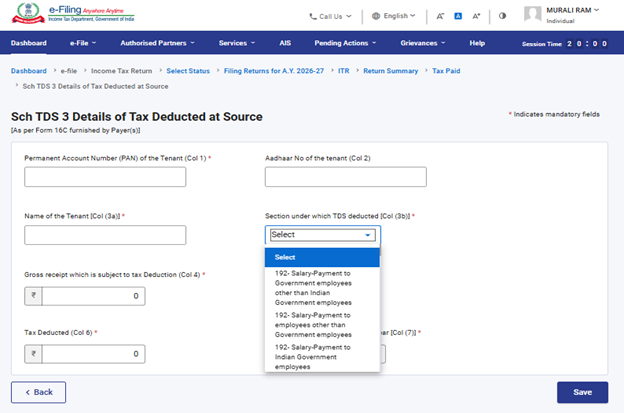
34. Do I need to select TDS section mandatorily while filling in the TDS details under TDS schedule of ITR-1 for AY 2026-27?
Yes, if you want to claim TDS you have to mandatorily select the section under which TDS is deducted.